00 The illustrated field manual

Understand LLMs.
Choose the right one.
Put it to work.

A clear, independent field guide to large language models, without the hype.

No jargon requiredBuilt for real decisionsUpdated as the field changes
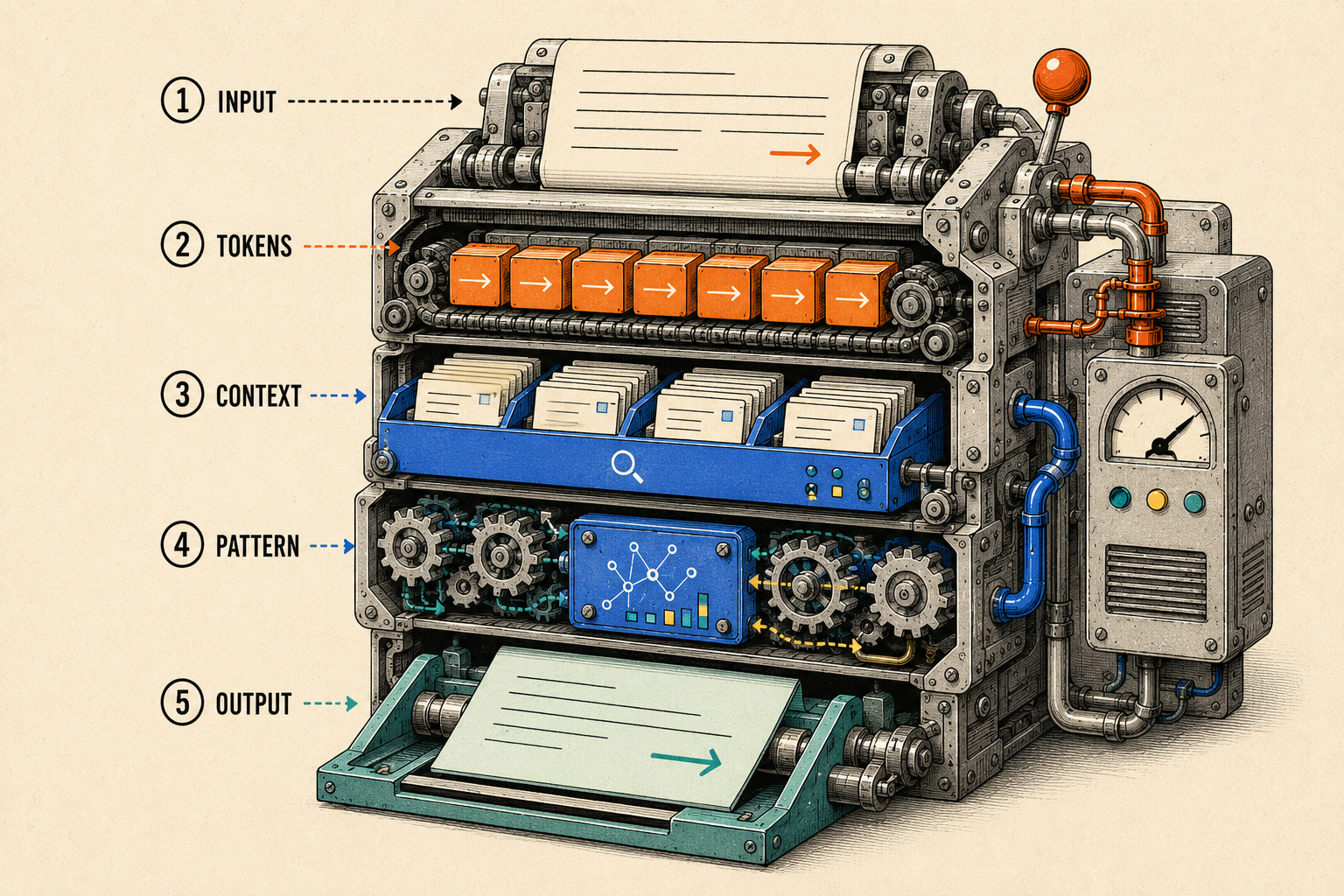
Cutaway illustration showing a prompt becoming tokens, gathering context, passing through pattern processing, and producing an answer01 / INPUT03 / CONTEXT05 / OUTPUT
ROUTING CONSOLE / SELECT A PATH

What are you trying to do?

SAMPLE INPUT

Turn these rough notes into a clear, friendly project update.

EXPECTED OUTPUT

A concise update with decisions, progress, and next steps.

Start with prompting
CHAPTER 01THE 5-MINUTE GUIDE

01 Start here

Five things that make the rest make sense.

You do not need to understand neural-network mathematics to use an LLM well. You do need a useful mental model for what it can and cannot do.

  1. 01

    It predicts language

    An LLM builds a response piece by piece from patterns learned during training. It does not retrieve a single stored answer from a database.

    CORE IDEA
  2. 02

    Context changes the answer

    Your instructions, examples, source material, and conversation history shape what the model can produce right now.

    INPUT
  3. 03

    Fluency is not truth

    A confident sentence may still be wrong. Verification matters whenever facts, money, safety, reputation, or people are involved.

    CAUTION
  4. 04

    Different models fit different jobs

    Quality, speed, price, privacy, context size, tool use, and deployment options all matter. There is no permanent universal winner.

    CHOICE
  5. 05

    Evaluation beats intuition

    Test models with examples from your actual work. A small repeatable test set is more useful than a leaderboard alone.

    PRACTICE

02 Under the cover

One prompt.
Five useful stages.

This is a simplified map, not a literal diagram of every model. It is enough to reason about prompting, retrieval, and output quality.

01INPUT

Instructions + material

02TOKENS

Text becomes pieces

03CONTEXT

Relevant information

05OUTPUT

Pieces become an answer

CHAPTER 02CHOOSE BY FIT

03 Model fit finder

Skip the model horse race.

The “best” model depends on what you are doing and what you value. Start with the shape of the job, then test named models against it.

01 What kind of work?
02 What matters most?
QUALITYSPEEDCOSTPRIVACYCONTROL
CHAPTER 03PUT IT TO WORK

04 Prompt workbench

Give the model something to work with.

Good prompts are not magic spells. They reduce ambiguity by making the goal, audience, material, constraints, and quality bar visible.

PROMPT ASSEMBLY / FIVE PARTS
01
Role

What perspective or expertise is useful?

02
Goal

What should the result accomplish?

03
Context

What information should it use?

04
Constraints

What format, length, or boundaries apply?

05
Quality check

How should it inspect its own answer?

EDITABLE PROMPT / P-001~70 TOKENS
Token count is a rough estimate and varies by model.
Before sending:Is the goal clear?Did you include the source material?Do you know what must be verified?

05 Choose your route

You do not need to learn everything.

Follow the route that matches what you want to make.

ROUTE / 01

HOBBYIST

Make something useful tonight

  • Prompt basics
  • Image + text workflows
  • Personal projects
Open route
ROUTE / 02

BUILDER

Turn a model into a product

  • APIs + structured output
  • Retrieval
  • Evaluation
Open route
ROUTE / 03

TECHNICAL

Understand the machinery

  • Tokens + context
  • Open weights
  • Fine-tuning
Open route
ROUTE / 04

TEAM

Adopt it without chaos

  • Use-case selection
  • Risk controls
  • Shared playbooks
Open route
CHAPTER 04TRANSLATE THE JARGON

06 Plain-language glossary

Know the term.
Keep moving.

01

Agent

A system that lets a model choose and perform steps toward a goal, often using tools.

02

Context window

The amount of information a model can consider in one interaction.

03

Embedding

A numerical representation used to compare meaning and retrieve related information.

04

Hallucination

A plausible-sounding response that is unsupported, incorrect, or invented.

05

Inference

The process of running a trained model to produce an output.

06

Open-weight

A model whose learned parameters are available under a specified license.

07

Prompt

The instructions and information provided to a model.

08

RAG

Retrieval-augmented generation: finding relevant material and supplying it as context.

09

Temperature

A setting that influences how predictable or varied generated text may be.

10

Token

A piece of text processed by a model. A word may be one token or several.

11

Transformer

The neural-network architecture behind most modern language models.

12

Tool use

A model requesting an external action such as searching, calculating, or calling an API.

07 Your next move

Pick one real task.
Run one small experiment.

Start with work you can inspect. Keep what helps. Measure what matters. Add autonomy only after the simple version is trustworthy.

Choose a route